Build contextual quality signals
Created 41 indicators describing how news domains appear and circulate, then prepared reproducible datasets for modeling.
Balancing personal relevance with independent signals about the reliability of recommended news domains.
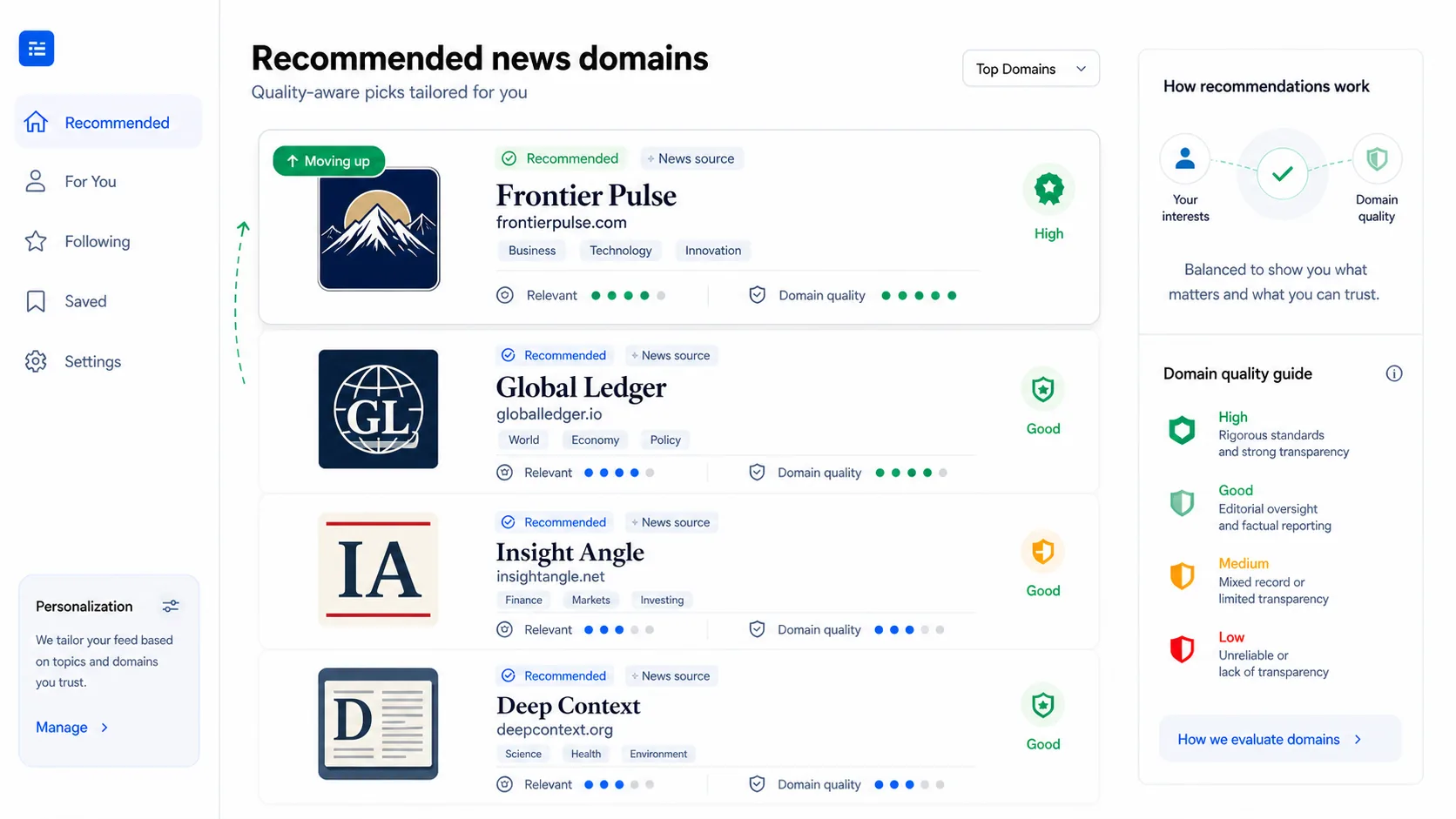
Conventional recommenders optimize for what a user is likely to engage with. In a news environment, that objective can unintentionally promote unreliable domains. Product and research teams need a way to make information quality measurable without discarding personalization.
Created 41 indicators describing how news domains appear and circulate, then prepared reproducible datasets for modeling.
Compared learned domain-quality estimates with NewsGuard ratings to establish whether the signals captured meaningful reliability information.
Combined relevance-focused recommendation with learned domain-quality signals through a quality-aware re-ranking approach.
Compared the new approach with the baseline using recommendation precision and average quality of the recommended domains.
Designed data preparation, feature engineering, validation checks, model comparison, and reproducible experiment workflows.
Implemented and evaluated the recommendation pipeline, integrated learned signals, and communicated the relevance and quality trade-offs to collaborators.
The quality-aware approach increased the average quality of recommended news domains by 3 points while maintaining the precision achieved by the relevance-focused baseline.
Balance engagement with trust, quality, safety, diversity, or editorial objectives that matter to the product.
Add business-quality signals to ranking so relevance is not the only factor deciding what users see.
Turn an abstract quality concern into signals, experiments, and measurable trade-offs that teams can inspect.
Evaluate an existing ranking pipeline and integrate additional objectives without replacing the complete product architecture.
Share the current product, available data, and the trade-off you need to measure.